
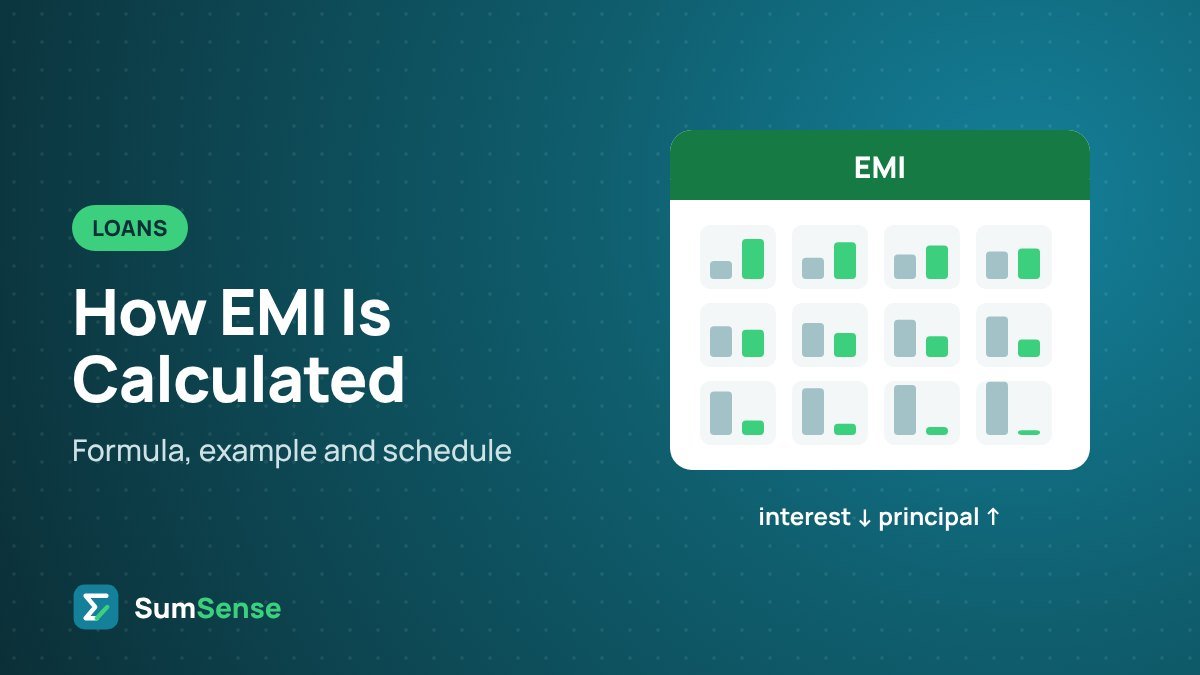
An EMI is a fixed monthly payment that covers the interest due for that month plus a part of the loan principal. Banks in India calculate it on a reducing balance, so interest is charged only on what you still owe.
The EMI formula
EMI = P × r × (1 + r)n ÷ ((1 + r)n − 1)
- P = loan amount
- r = monthly interest rate (annual rate ÷ 12 ÷ 100)
- n = number of monthly instalments
Worked example: ₹10 lakh at 9% for 5 years
- r = 9 ÷ 12 ÷ 100 = 0.0075
- n = 60
- EMI = ₹20,758
| Month 1 | Amount |
|---|---|
| Interest (₹10,00,000 × 0.75%) | ₹7,500 |
| Principal repaid (₹20,758 − ₹7,500) | ₹13,258 |
| Balance after month 1 | ₹9,86,742 |
In the first year you pay about ₹83,270 in interest and still owe about ₹8.34 lakh. Over five years, total interest is about ₹2.46 lakh. Check any loan in the EMI calculator and open the year-wise schedule.
Why early EMIs are mostly interest
Interest each month is charged on the outstanding balance. At the start the balance is highest, so most of the EMI goes to interest. As you repay, the interest part shrinks and the principal part grows. That is why prepaying early saves the most.
Watch out for “flat rate” loans
Some lenders quote a flat rate, charging interest on the full original amount for the whole tenure. A “9% flat” loan of ₹10 lakh for 5 years has an EMI of about ₹24,167 – the same as a reducing-balance loan at about 15.7%. Always ask for the annual percentage rate in the Key Fact Statement, which lenders must give you.
What changes your EMI
- Loan amount: EMI rises in direct proportion.
- Interest rate: on a ₹30 lakh, 20-year home loan, each 0.5% adds roughly ₹900–1,000 a month.
- Tenure: longer tenure lowers EMI but sharply raises total interest.
- Floating rates: when the RBI repo rate changes, banks usually adjust the tenure first; ask whether you can choose a higher EMI instead.
Compare lenders on our home loan rates and personal loan rates pages.