
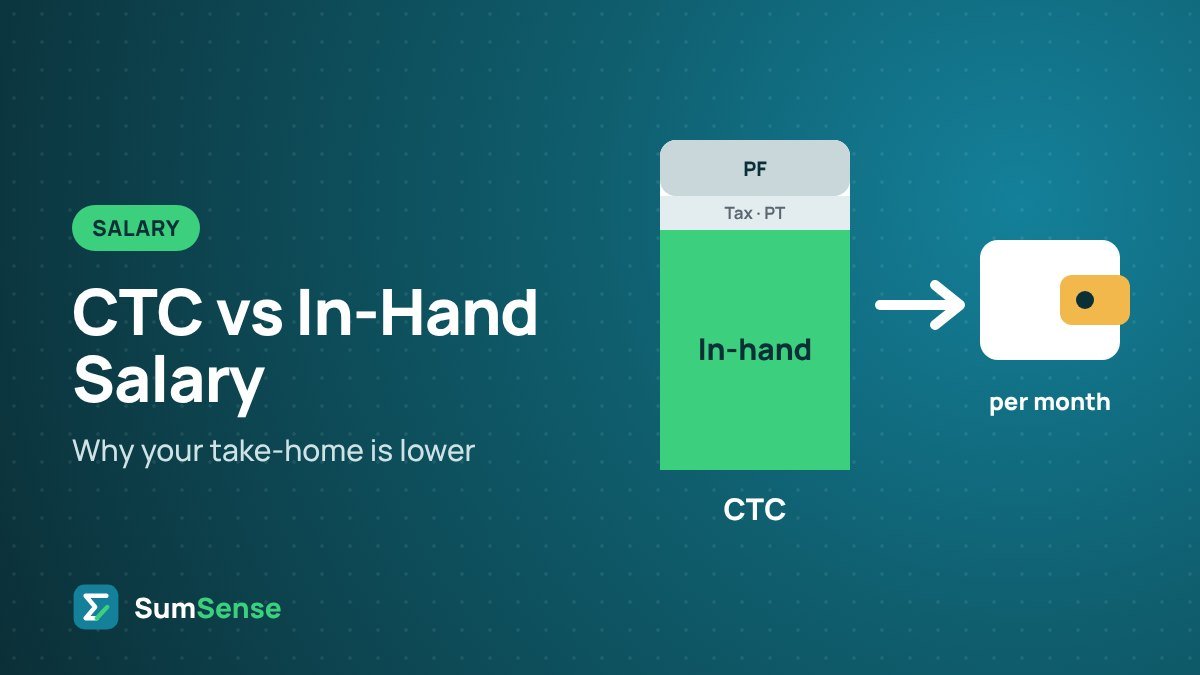
CTC (cost to company) is everything your employer spends on you in a year. In-hand salary is what reaches your bank account each month after PF, professional tax and income tax are deducted. The gap is usually 10–25%.
Worked example: ₹12 lakh CTC
Assume basic pay is 50% of CTC, PF is on full basic, the new tax regime, and Maharashtra professional tax.
| Item | Per year |
|---|---|
| CTC | ₹12,00,000 |
| Less: employer’s PF contribution (part of CTC, goes to your PF account) | – ₹72,000 |
| Gross salary | ₹11,28,000 |
| Less: your own PF contribution (12% of basic) | – ₹72,000 |
| Less: professional tax | – ₹2,500 |
| Less: income tax (nil – rebate under the new regime) | ₹0 |
| Take-home | ₹10,53,500 (about ₹87,800 a month) |
Try your own numbers in the salary in-hand calculator.
What is inside a typical CTC
- Basic salary – drives PF, gratuity and HRA.
- HRA – partly tax-free under the old regime if you pay rent (HRA calculator).
- Special allowance – fully taxable.
- Employer PF – 12% of basic (or of the statutory wage ceiling, if your employer caps it).
- Gratuity – some employers include about 4.81% of basic in CTC; you receive it only after the qualifying service (gratuity calculator).
- Variable pay / bonus – paid only if targets are met.
- Insurance and perks – group health cover, meal cards and similar.
What gets deducted every month
- Employee PF: 12% of basic – it is your savings, not a cost, but it lowers take-home.
- Professional tax: a state tax of up to ₹2,500 a year (nil in some states, such as Delhi and Uttar Pradesh).
- TDS: your employer deducts income tax monthly based on the regime you choose.
Questions to ask before accepting an offer
- How much of the CTC is fixed and how much is variable?
- Is gratuity or insurance premium included in the CTC?
- Is PF calculated on full basic or capped?
- What will my monthly in-hand be under the new regime?
Once you know your take-home, plan savings with the SIP calculator and compare tax regimes with the income tax calculator.