
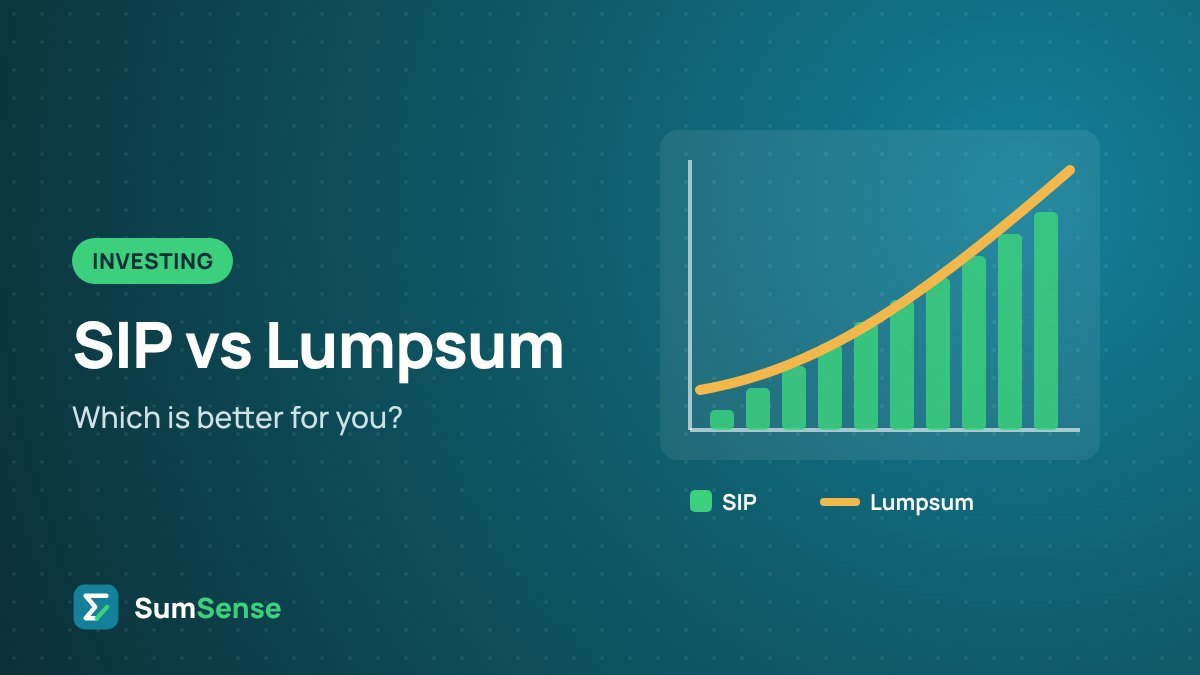
A lumpsum puts all your money to work at once; a SIP invests a fixed amount every month. If you already have the money and markets rise steadily, a lumpsum usually ends higher. A SIP reduces the risk of investing everything at a market peak and suits money you earn monthly.
Same ₹12 lakh, two ways (12% a year, 10 years)
| Approach | Invested | Value after 10 years |
|---|---|---|
| ₹12 lakh lumpsum on day one | ₹12 lakh | ≈ ₹37.3 lakh |
| ₹10,000 SIP every month | ₹12 lakh (spread over 10 years) | ≈ ₹23.2 lakh |
The lumpsum looks far better – but only because all the money was invested for the full 10 years, and real markets do not rise in a straight line. The comparison is fair only if you actually have ₹12 lakh today. Try both in the lumpsum calculator and SIP calculator.
How a SIP smooths the ride
Suppose you invest ₹10,000 a month for three months while the fund’s NAV moves ₹100 → ₹80 → ₹125. You buy 100, 125 and 80 units – 305 units for ₹30,000, an average cost of about ₹98.36, lower than the average NAV of ₹101.67. This is rupee-cost averaging: you automatically buy more when prices are low.
When each makes sense
| Choose a SIP when… | Choose a lumpsum when… |
|---|---|
| You invest from monthly salary | You receive a bonus, maturity or sale proceeds |
| You worry about market timing | Your horizon is long (7+ years) and you can sit through falls |
| You want discipline and automation | You are investing in debt funds or less volatile options |
The middle path: STP
Have a large amount but worried about a market high? Park it in a liquid or short-duration fund and move a fixed sum into equity every month through a systematic transfer plan (STP) over 6–12 months.
Tips
- Use a yearly step-up – raising your SIP by 10% each year makes a big difference over time.
- Choose direct plans to avoid distributor commission.
- Do not stop SIPs during market falls; that is when they work hardest.
- Estimate tax on gains with the capital gains calculator.
Mutual fund investments are subject to market risks. Past returns do not guarantee future returns.