
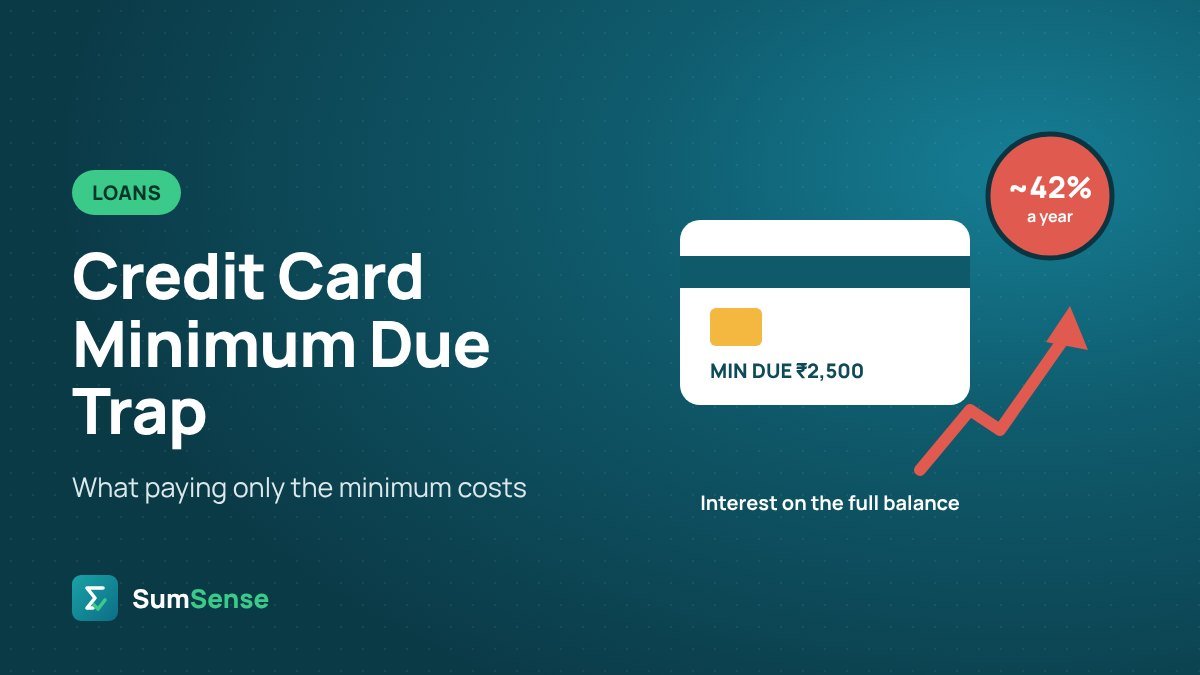
Paying the minimum amount due keeps your card in good standing, but interest of roughly 3–3.75% a month (about 36–45% a year) is charged on the full unpaid balance. New purchases also lose their interest-free period until the bill is cleared in full.
How the minimum due is worked out
Most banks set it at about 5% of the outstanding, plus all interest, fees and taxes, plus any EMI instalments and overlimit amount. It is designed to keep you current, not to clear the debt.
What one ₹50,000 bill can cost
Suppose you pay only the minimum (5%, or at least ₹200) every month, at 3.6% monthly interest plus 18% GST on that interest, and make no new purchases:
| Scenario | Time to clear | Total paid |
|---|---|---|
| Pay the full ₹50,000 by the due date | One month | ₹50,000 |
| Pay only the minimum each month | About 25 years | About ₹2.58 lakh |
Interest is also charged from the date of each purchase, not from the due date, so the real cost is often higher.
Your rights under RBI rules
- A late payment charge applies only if even the minimum is unpaid, and is calculated on the amount outstanding after the due date.
- An account can be reported as overdue or charged a late fee only after it is more than 3 days past due.
- Unpaid fees, charges and taxes cannot be added to the balance on which interest is charged.
- The bill must show how the interest-free period is lost if you pay less than the full amount.
- If the bank does not resolve your complaint within 30 days, you can go to the RBI Ombudsman.
How to get out of card debt
- Stop using the card for new purchases until it is cleared.
- Convert to EMI – card EMIs usually cost far less than revolving interest.
- Personal loan: at typically 11–16% a year, it can replace 40% card interest. Compare EMIs with the personal loan EMI calculator.
- Balance transfer to another card with a low introductory rate, then repay within that period.
- Set up autopay for the full amount once you are clear.
Effect on your credit score
Paying the minimum on time avoids a missed-payment mark, but a high balance relative to your limit (above about 30%) still pulls your score down. See how to improve your CIBIL score and compare cards on our credit cards page.
Frequently asked questions
What happens if I pay only the minimum due on my credit card?
You avoid a late fee, but interest of roughly 3–3.75% a month is charged on the full unpaid balance and new purchases lose the interest-free period.
When can a bank charge a late fee on a credit card?
Only if even the minimum is unpaid and the account is more than 3 days past the due date.