
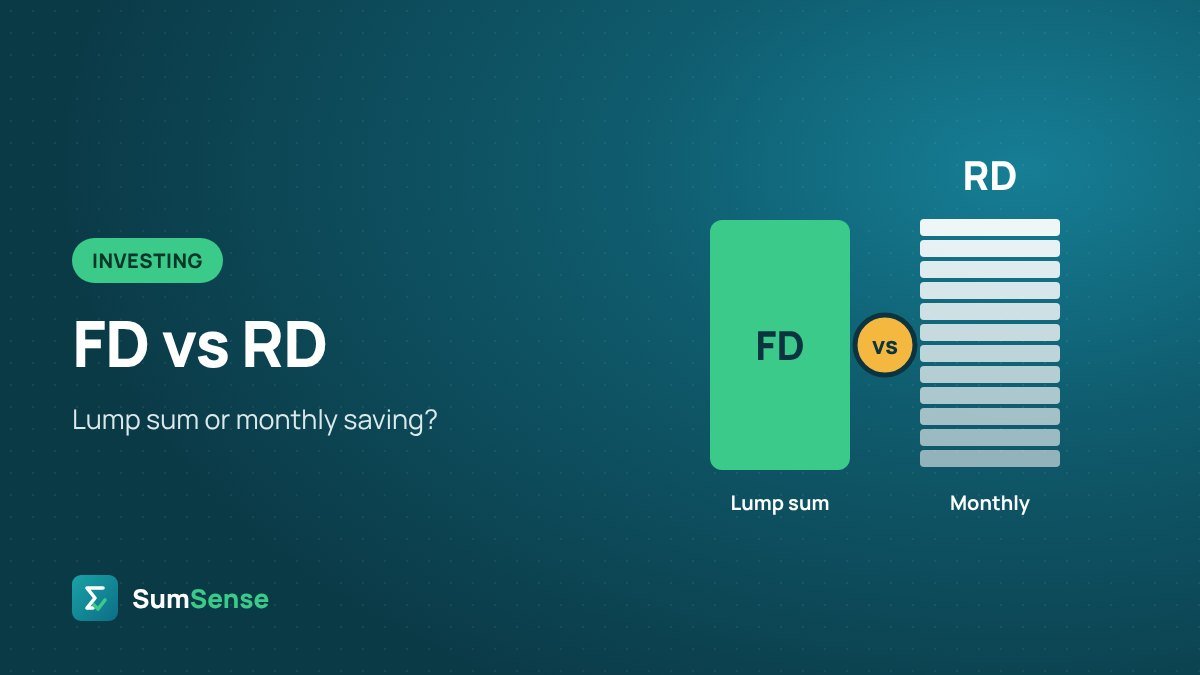
Choose an FD when you already have a lump sum. Choose an RD when you want to save a fixed amount every month. At the same rate, an FD earns more in rupees only because your money is invested for longer.
Side by side
| Fixed deposit (FD) | Recurring deposit (RD) | |
|---|---|---|
| How you invest | One lump sum | Fixed amount every month |
| Interest rate | Set at booking | Usually the same as an FD of the same tenure |
| Tenure | 7 days to 10 years | 6 months to 10 years |
| Missed payment | Not applicable | Penalty; account may close after repeated misses |
| Premature withdrawal | Allowed with a penalty | Allowed with a penalty |
| Tax | Interest taxed at your slab rate | Interest taxed at your slab rate |
Worked example: ₹1.2 lakh over a year at 7%
| Option | You put in | Maturity | Interest |
|---|---|---|---|
| FD: ₹1,20,000 at the start | ₹1,20,000 | ₹1,28,623 | ₹8,623 |
| RD: ₹10,000 a month | ₹1,20,000 | ₹1,24,621 | ₹4,621 |
Both use quarterly compounding. The RD earns less because each instalment stays invested for a shorter time – not because the rate is worse. Check your own figures with the FD calculator and RD calculator.
Tax and TDS
- Interest on both is added to your income and taxed at your slab rate, whether you withdraw it or not.
- Banks deduct 10% TDS once your total interest from that bank goes above ₹50,000 in a year (₹1 lakh for senior citizens). See TDS on FD interest.
- A 5-year tax-saver FD qualifies under Section 123 (old 80C) in the old regime. RDs don’t.
Which one fits you
- Bonus, maturity proceeds or savings already in hand: FD.
- Building a goal from monthly salary (a holiday, a gadget, an insurance premium): RD.
- Emergency fund: keep it in a sweep-in FD or several small FDs so you can break one without touching the rest.
- Five years or more: compare with PPF or a SIP.
Getting a better rate
- Small finance banks often pay more than large banks; deposits up to ₹5 lakh per bank are insured by DICGC.
- Senior citizens usually get an extra 0.25%–0.75%.
- After the RBI raised the repo rate to 5.50% in October 2026, deposit rates may move up – shorter FDs let you reinvest sooner.
- Compare current offers on our FD interest rates page.
Frequently asked questions
Is FD or RD better?
Choose an FD when you have a lump sum and an RD when you want to save a fixed amount every month. At the same rate, an FD earns more in rupees only because the money stays invested longer.
Is TDS deducted on RD interest?
Yes. TDS applies to both FD and RD interest once your total interest from a bank crosses ₹50,000 a year (₹1 lakh for senior citizens).